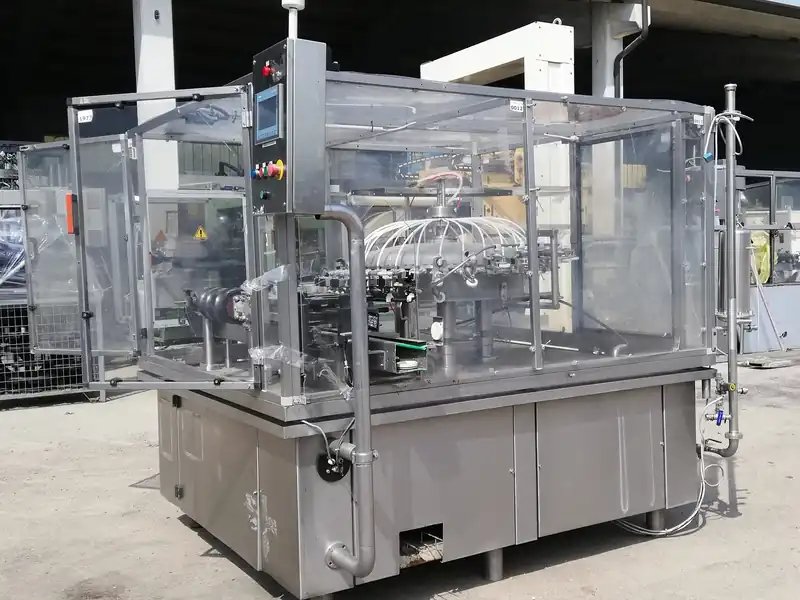
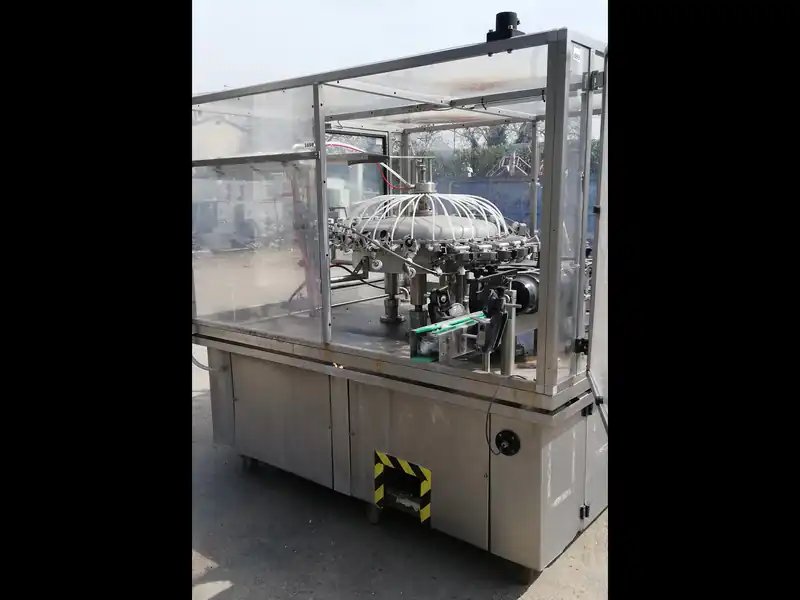
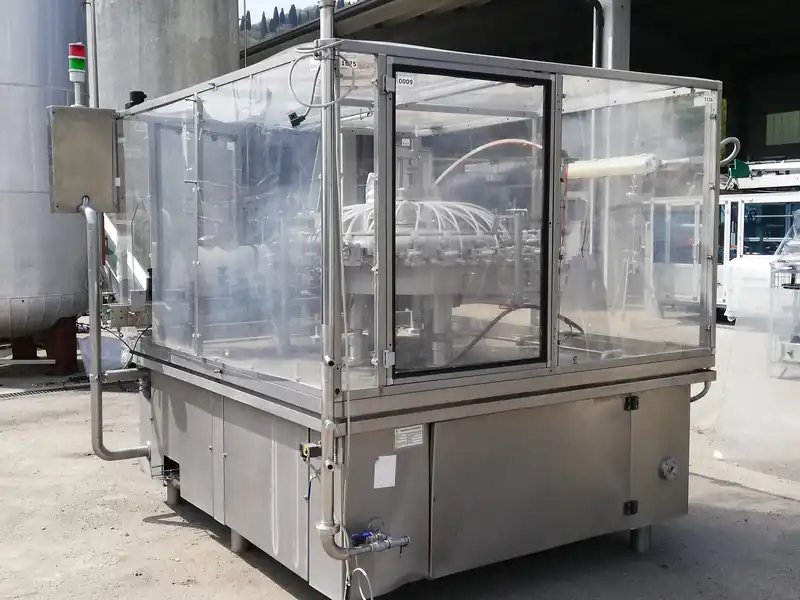
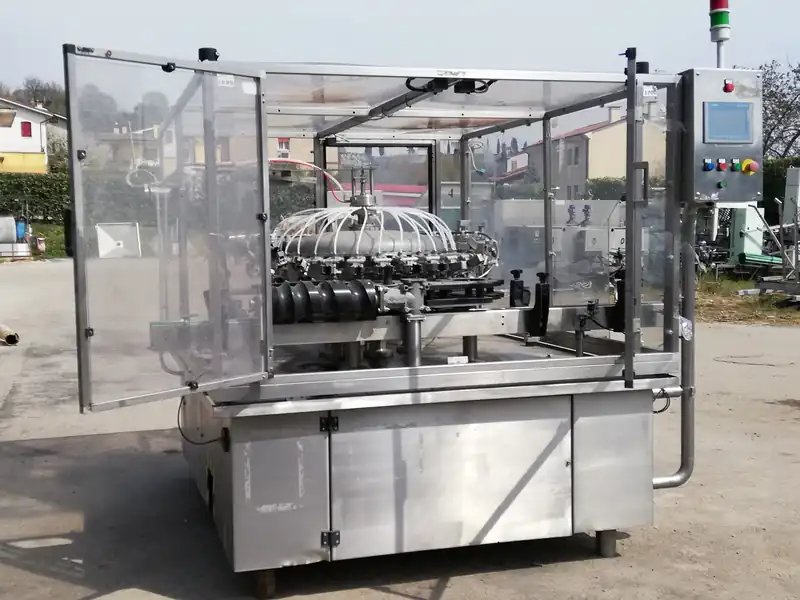
Technical Specifications & Performance Data This rotary glass bottle
rinser from Vir Mauri is a robust second hand solution for beverage
production lines seeking reliable pre-filling sanitation. Fully
overhauled, it offers stable throughput for medium-speed operations
and integrates seamlessly into a used bottling line focused on rinsing
prior to filling, capping, and labeling. Manufacturer: Vir Mauri Year
of manufacture: 1990 Category: Rinsing Machine (rotary) Operating
speed: up to 7,000 bottles per hour (BPH) Container types: Glass
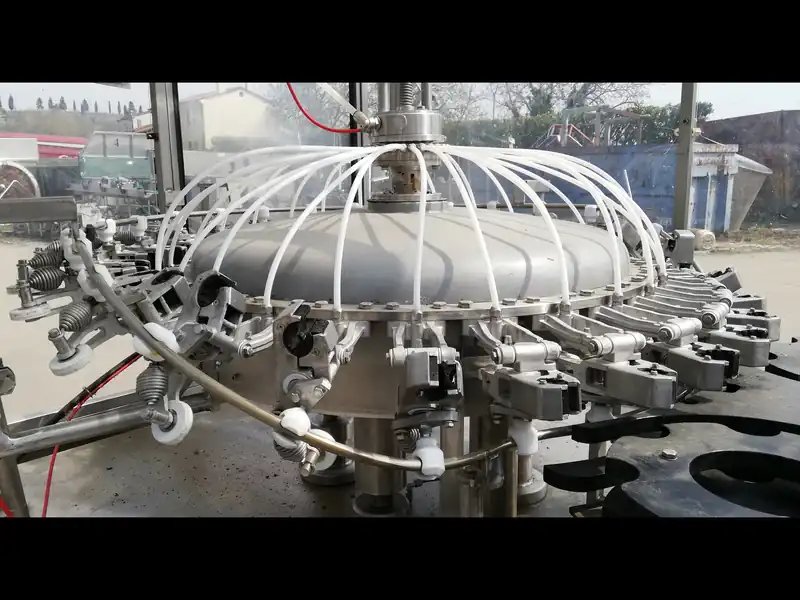
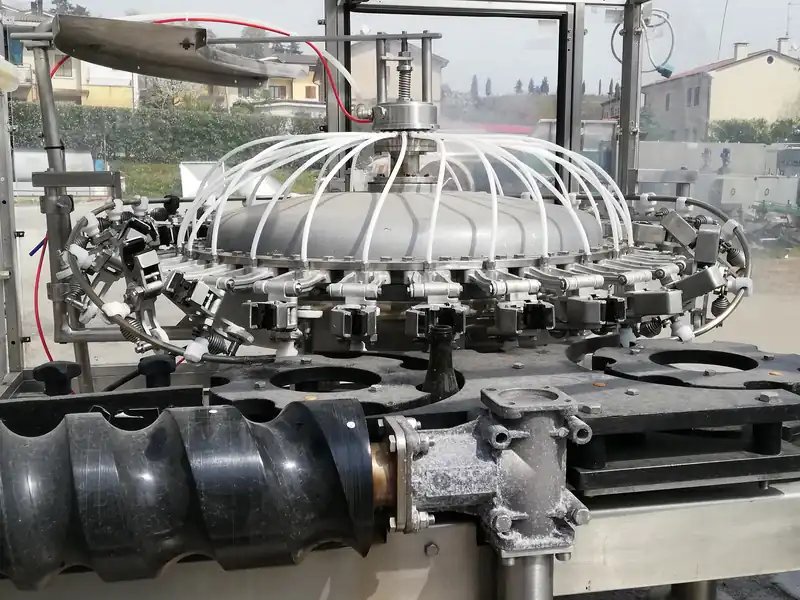
bottles Bottle handling: 28 grippers, clockwise rotation Nozzle
configuration: movable/penetrating spray nozzles Treatment:
single-stage water rinse Machine condition: overhauled, in storage
Safety features: included (guards and emergency stops) Advanced
Automation & Control Systems Designed for dependable operation in
industrial packaging environments, this rinser features a practical
control setup for daily production. The overhauled unit provides
straightforward operator commands for start/stop, speed adjustment
within its nominal range, and alarm signaling to support uptime and
routine maintenance. Safety interlocks on guards and emergency stop
circuits are included to protect personnel during operation and
changeovers. Operator control panel for core functions and status
indication Speed regulation aligned to filler infeed requirements
Guard interlocks and e-stop circuits for safe operation Common
industrial interface points to line controls (e.g., enable/fault
contacts) Production Line Integration Capabilities Engineered for
smooth integration ahead of filling, this Vir Mauri rinser is well
suited to glass bottle lines handling water, juice, beer, wine, and
related beverages. It interfaces with standard infeed/outfeed
conveyors and can be synchronized with downstream filling and capping
equipment as well as upstream conveyors, inspection, or accumulation.
While dedicated to glass, it can operate within mixed-material
facilities where other machines process PET or aluminum containers on
separate lines. Compatible with common fillers, cappers, labelers, and
inspection systems Clockwise rotation aligns with typical starwheel
and conveyor layouts Changeovers supported via bottle handling parts
appropriate to each format Ideal component within a used bottling line
for beverage production Machine Condition & Maintenance History The
unit is second hand and has been overhauled to ensure functional
reliability, focusing on critical wear components such as grippers and
rinse nozzles. It is currently in storage for rapid dispatch and
installation planning. Routine maintenance remains straightforward,
emphasizing water quality control, periodic nozzle inspection, and
gripper alignment to preserve consistent rinsing performance at 7,000
BPH. Operational Performance & Versatility This rotary rinser is
optimized for glass bottles and single-stage water rinsing, providing
an effective cleanliness baseline ahead of filling. It serves diverse
beverage categories—including still or sparkling water, beer, wine,
juice, and soft drinks—by removing particulates and dust prior to
product contact. The 28-gripper carousel and penetrating nozzles
support stable bottle handling and targeted rinsing while maintaining
throughput and line efficiency. Consistent, repeatable rinsing quality
for glass containers Effective pre-treatment for a wide range of
beverages Supports hygienic process flow before filling, capping, and
labeling Installation Requirements & Site Preparation For reliable
operation, prepare a level, cleanable floor area with clear access for
conveyors and guarding. Provide a suitable electrical supply, potable
or filtered process water of appropriate quality for the rinse, a
drain connection for effluent management, and, where applicable,
compressed air for actuating components. Proper alignment with infeed
and outfeed conveyors ensures smooth bottle transfer and minimized
downtime during format changes. Stable, level footprint for rotary
base and guarding Process water supply and drainage with adequate flow
and filtration Electrical supply compatible with standard industrial
specifications Conveyor integration space for efficient infeed/outfeed
transfer Safety Standards & Compliance Certification Safety features
include protective guards, interlocked access points, and emergency
stop devices to support operator protection during operation and
maintenance. Hygienic design practices facilitate routine cleaning
around product-contact zones and structural elements. Verification of
compliance with local regulations and plant safety policies is
recommended during commissioning to align with site-specific standards
for industrial packaging and beverage production. Interlocked guards
and emergency stop circuits included Design facilitates routine
sanitation of contact and splash areas Supports integration into
facility-wide safety and quality procedures




 Itália
Via G. Verdi, 15 36021 Villaga (VI)
Itália
Via G. Verdi, 15 36021 Villaga (VI)